
Asset discovery and coverage
Identification of in-scope IP addresses, hosts, services, operating systems and network components. We also review inventory completeness and assessment coverage.
VULNERABILITY MANAGEMENT · HUNGARY
A structured assessment of known, potential and configuration-related security weaknesses across your IT environment. Tool-assisted discovery is complemented by expert analysis and manual validation, turning raw findings into a risk picture your teams can act on.
Request a consultation ↗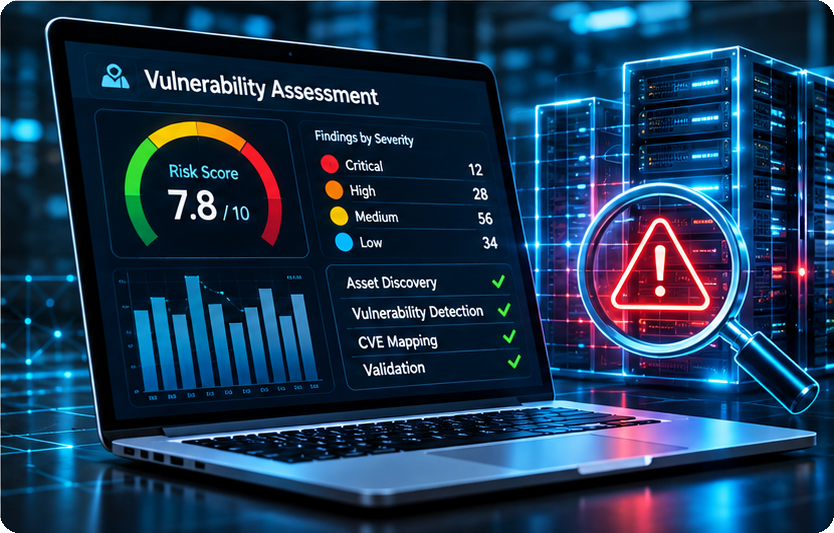
ASSESSMENT COVERAGE
The assessment is tailored to the agreed asset inventory, access model and objectives.
Identification of in-scope IP addresses, hosts, services, operating systems and network components. We also review inventory completeness and assessment coverage.
Versions, patch levels and configurations are reviewed against available vulnerability intelligence. Relevant CVEs are assessed in context rather than treated as equally applicable.
Review of security settings, exposed services, cryptographic configurations and hardening gaps, tailored to the system type and assessment scope.
Technical results are reviewed; where feasible, false positives are filtered and applicability and relevance are clarified before findings are reported.
OUR APPROACH
A Vulnerability Assessment focuses on broad identification and prioritisation of weaknesses. It does not attempt to chain selected flaws or demonstrate impact through controlled exploitation—that is the focus of penetration testing. Priorities consider technical severity, asset criticality, reachability, exposure, potential business impact and available mitigations. Scanner scores alone do not determine remediation order.
VULNERABILITY ASSESSMENT VS. PENETRATION TEST
A Vulnerability Assessment broadly identifies and prioritises potential weaknesses. A penetration test safely exploits selected findings to demonstrate practical attack paths or impact. The services complement each other: assessments support recurring risk visibility, while penetration testing provides deeper, targeted validation.
FAQ
The agreed asset scope is reviewed through service and version identification, known vulnerability checks, relevant configuration review, analysis of results and remediation prioritisation. Coverage and testing approach are tailored to the environment, access model and objectives.
No. Automated tools provide efficient coverage, but raw scanner output is not a finished assessment. We review findings, validate applicability where feasible and add context to reduce false positives and make results meaningful for your environment.
A Vulnerability Assessment primarily identifies, analyses and prioritises potential weaknesses. Controlled exploitation and demonstration of practical attack impact belong to penetration testing. If exploit validation is required, its method, boundaries and risks are agreed separately and performed with explicit authorisation.
Yes. Testing can use an unauthenticated external perspective or approved test accounts. Authenticated assessments can reveal additional configuration and patch-state issues, while unauthenticated testing focuses on exposure visible without credentials. The access model is selected based on objectives and agreed safety boundaries.
Priorities combine technical severity, exploitability, asset criticality, internet or internal reachability, potential business impact and available mitigations. CVSS is a useful input, but does not replace contextual risk assessment.
The report outlines scope, approach and coverage; validated findings; severity and risk context; supporting evidence; and practical remediation or mitigation guidance. It is designed to support technical remediation, with an executive summary to help stakeholders understand and prioritise risk.
Frequency depends on how quickly the environment changes, asset criticality, exposure, patch-management maturity and risk appetite. Alongside recurring assessments, targeted reviews may be appropriate after major changes, new internet-facing services, infrastructure updates or disclosure of critical vulnerabilities.
After fixes, a scoped retest can verify that the vulnerability is resolved, configuration changes are effective and the original exposure no longer remains. Retest scope and depth are agreed in advance.
CONTACT
Let’s discuss your asset inventory, coverage and objectives and define a practical assessment plan.